- Articles
- Book Reviews
- Movie Reviews
- Letters
- Thought for the Day
- Today's News
- Bookmarks
- Sponsors
- Submissions
- Fisher House Publishers
- About Living Better

Enter for a free trip to Tahiti

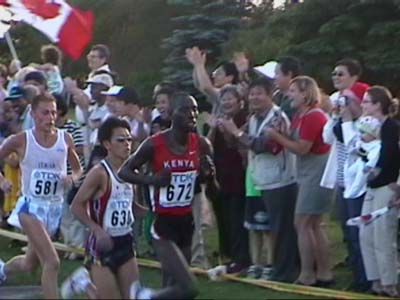
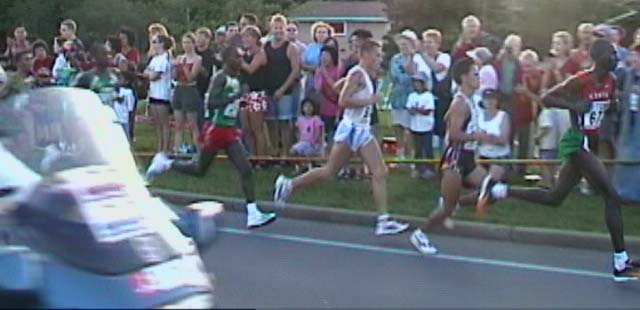
Three marathon front runners at 1 hour 45 minutes: Kenya's Simon Biwott, who placed second; Japan's Shigeru Aburaya, who placed fifth; and Italy's Stefano Baldini, who won bronze. (Melanie Fisher photo) World track and field
games begin impressively
It was a spectacular start to the Track and Field World Games, which began August 3, 2001, in Edmonton, Alberta, Canada. At 6:45 p.m. during the opening ceremonies marathon runners left a packed stadium to polite applause. Two hours and 12 minutes later the two front runners, Simon Biwott of Kenya and Gezahegne Abera of Ethiopia, re-entered the stadium to a thunderous welcome. In the final 200 meters run in the stadium, Abera passed Biwott and Ethiopia won the gold in 2:12.42 with only five feet between the two front-runners. "This time he was very strong," commented the Kenyan. "I respect him. He has won." The two rivals will meet again in future marathons. Abera, at 23-years-old, is now the gold medal champion of both the Worlds and the Olympics, winning the latter last year in Sydney, Australia. Morning marathons begin and end at an empty stadium. By making the marathon part of the opening ceremonies, the Edmonton organizers assured a great welcome for the marathon runners and got spectators right into the games. The opening ceremonies, usually a humdrum event, became charged with an electricity that would carry through the rest of week's events. As the host country five Canadians were allowed to enter the marathon. All finished. The two runners from the United States didn't reach the stadium. It was a grueling 42.2 km, but in ideal running weather, cool with a slight breeze. Second time marathoner Canadian Steve Bohan came in 42nd, 17 minutes after first place Abera. As he entered the stadium, the audience went wild, as it did for each of the other Canadian runners. Bohan, who runs 10,000-meter races for the University of West Virginia where he is getting a master's degree in secondary education, inspired by the audience, charged past Ernest Ndjissipou of the Central African Republic to the finish line. Canada's best marathoner, Bruce Deacon, who placed 27th at the Sydney Olympics, placed 46th in Edmonton. Oliver Utting placed 65th and Christian Marmen and Fraser Bertram were last to finish, in 72nd and 73rd place (2:45.10). A hundred runners entered the race. All along the 42 km route spectators clapped and cheered the racers. However, the loudest applause was for the hometown Canadians. "It was a thrill to see the runners," said Edmontonian Mary Greeves. "The race ran right behind my house. I don't know how I could be so lucky. For me, it was a once in a lifetime event." Bertram, whose best run was second place in 1998 at the Detroit marathon (2:20.06), struggled to keep in the race. Every time he stopped to get rid of a cramp, the spectators along the route went wild. The support was incredible, he said afterwards. The U.S. favorite and probably the world's fastest marathoner, Moroccan-born Khalid Khannouchi, who came to the United States eight years ago, suffered from blisters. He dropped out after 16 miles. Edmonton won the bid to have the World Championships from Paris and Stanford, California. It proved to be a good decision for the IAAF who chose the northern city over its more populous rivals. The games showed a profit even before beginning. Also, as one visitor confirmed, Edmonton is one of the friendliest places in the world. (For more coverage go to the IAAF home page <http://www.iaaf.org>.)
|